
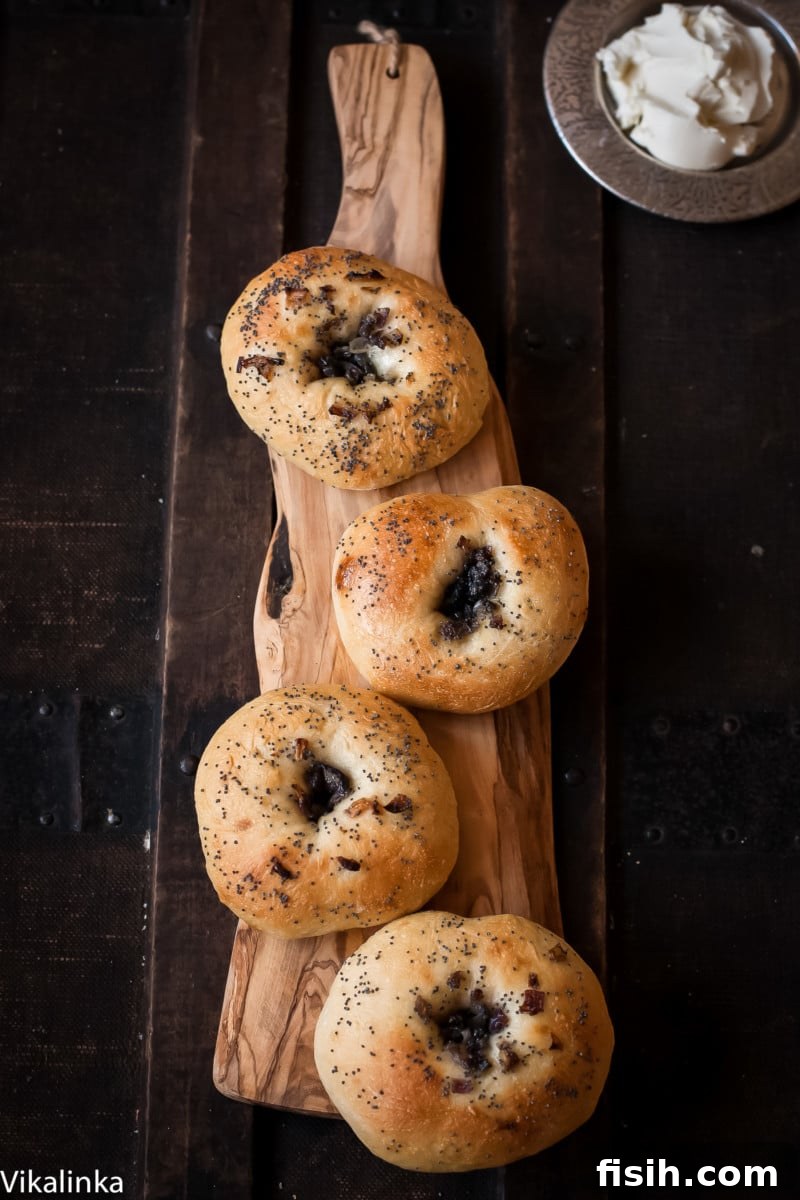
Homemade Savory Onion and Poppy Seed Bialys: An Eastern European Delight
For many, certain foods evoke a powerful sense of home and nostalgia. For me, bagels consistently rank among the top five comfort foods I crave from my past. It’s no surprise then that the very first thing I sought out upon landing in Canada during my last Christmas visit was an everything bagel, generously slathered with herb and garlic cream cheese. This simple pleasure immediately transported me back to cherished memories and familiar tastes.
Bagels hold a truly special place in my culinary journey. When I first relocated to America, I was genuinely taken aback by the ubiquitous white bread – often spongy, lacking substance, and with a disconcerting tendency to stick to the roof of my mouth. I desperately longed for the kind of crusty, robust bread I grew up with, one that offered both a satisfying chew and a pillowy soft interior. However, living in a college dorm, I had no access to an oven, and more importantly, absolutely no idea how to bake bread from scratch. This void in my diet felt significant and deeply missed.
Little did I know, my culinary world was about to be transformed. One day, a friend suggested a stop at a local bagel shop. The word “bagel” was entirely new to me, an unfamiliar term for an unknown food. Yet, the moment I took that first bite, there was an unmistakable recognition. The texture, the flavor, the sheer satisfaction – I instinctively knew what it was, and somehow, I felt like I had experienced it before. It was a revelation, a taste of home in an unexpected form.
The True Heritage of Bagels: Beyond New York City
While bagels are almost synonymous with New York City, largely due to the thriving Jewish immigrant communities that popularized them there, it’s crucial to acknowledge their deeper roots. And let me make a disclaimer right here: this isn’t about starting a “new world vs. old world” culinary debate! The truth is, New York City is not where bagels originated. Their true birthplace lies in Eastern Europe, a region rich in diverse bread-making traditions.
Jewish immigrants brought bagels, known by various names such as “bubliki” or “baranki” in Russia, and a host of other terms across Polish, Ukrainian, and Czech cultures, from their homelands. These delightful, ring-shaped breads were a staple in Eastern European kitchens long before they crossed the Atlantic. They are a testament to the ingenuity and culinary heritage of these communities, and in a very real sense, the world truly “owns” bagels thanks to their Eastern European legacy.
A compelling historical visual, such as the National Geographic photo from 1970s Moscow, beautifully illustrates this heritage, showing a street vendor proudly selling bubliki. This image provides a tangible link to the long and storied history of these cherished baked goods, highlighting their integral role in the daily life and culture of the region.
Meet the Bialy: Bagel’s Simpler, Equally Delicious Cousin
At this point, you might be wondering what a bialy recipe has to do with the conversation about bagels. Well, allow me to introduce you to the bialy, a very close, yet distinct, cousin to the bagel. These savory onion and poppyseed buns share a similar ancestry with bagels but boast some distinct advantages, especially for the home baker.
What makes a bialy so special? Unlike bagels, which are traditionally boiled before baking to achieve their signature chew and crust, bialys are simply baked. This omission of the boiling step makes them significantly easier to prepare at home, cutting down on both time and complexity. Furthermore, bialys are renowned for their impressive freshness; they remain soft and delicious for several days, a stark contrast to bagels which are often best enjoyed within 24 hours of baking. Crucially, with their soft, slightly indented center perfect for holding fillings, bialys are truly *made* for sandwiches. They also make an incredibly satisfying breakfast, paired wonderfully with a dollop of cream cheese and a freshly brewed cup of coffee.
Achieving the Perfect Chewy Crust at Home
One of the most coveted characteristics of a perfectly baked bread, whether it’s a bagel, a bialy, or a rustic loaf, is that delightful, chewy crust. This texture is primarily achieved through the presence of steam during the initial stages of baking. Commercial ovens are expertly designed to trap steam, creating the ideal environment for that wonderful “chew” we all adore. For home bakers, replicating this professional environment can be a challenge, especially if you, like me, have an oven that’s on the smaller side – think perhaps two-thirds the size of a standard North American oven.
However, fret not, fellow home bakers! There’s a clever trick you can employ to achieve that coveted chewy crust right in your own kitchen. Simply place a rimmed baking sheet, filled about one-third of the way with water, on the lowest rack of your oven. As your bialys bake on a higher rack, the heat will cause the water to evaporate, producing a consistent stream of steam. This homemade steaming method helps to gelatinize the starch on the surface of the dough, preventing the crust from hardening too quickly and ensuring a beautifully chewy texture that will have you coming back for more.
The Magic of Homemade Bialys: Easy to Make, Hard to Resist
The dough for these savory onion and poppyseed bialys is incredibly forgiving and simple to work with. It consistently yields beautifully airy buns crowned with that desirable, slightly chewy crust – a pure beauty in every bite! The reward for your efforts is truly magnificent, producing a batch of buns that are both tender and satisfyingly firm.
During our first baking attempt, we devoured about half the batch almost immediately after they emerged from the oven, unable to resist their warm, fragrant allure. Luckily, this generous recipe yields approximately 18 bialys, ensuring we had plenty to enjoy for the remainder of the week. As I mentioned, my husband, Brad, even made sandwiches to take to work with these, and he reported that even on day four, they were absolutely delightful! Their ability to retain freshness and flavor over several days truly sets them apart, making them an ideal choice for meal prepping or simply having delicious homemade bread on hand.
5 out of 5 stars based on 7 ratings
Savoury Onion and Poppyseed Buns {Bialy}
By Julia Frey of Vikalinka

Soft buns with a chewy crust, filled with savory onion and poppy seeds. A delightful Eastern European treat perfect for sandwiches or a snack.
Ingredients
- 950 g / 7.5 cups bread flour (I used Canadian bread flour for its high protein content)
- 5 tsp sea salt
- 2 tsp dry yeast (active or instant)
- 710 ml / 3 cups water (lukewarm for yeast activation)
For the filling
- 2 tbsp olive oil
- 1 large onion, finely chopped (red onion works beautifully for a touch of sweetness)
- 1 tbsp poppy seeds (plus more for sprinkling)
Instructions
- In the bowl of a stand mixer fitted with a dough hook attachment, whisk together the flour, salt, and dry yeast for a few seconds to combine. Add the water and mix on low speed until it forms a cohesive, elastic dough, which typically takes about 5 minutes. The dough should eventually pull away cleanly from the sides of your mixing bowl. Cover the bowl with plastic wrap and let it rise in a warm place for approximately 2 hours, or until it has noticeably doubled in size.
- Once risen, gently turn your dough out onto a lightly floured surface. Form the dough into a smooth ball. Using a sharp knife or dough scraper, portion the dough into approximately 18 golf ball-sized pieces. Cover these portions and let them rest for another 1 hour to relax the gluten, which will make them easier to shape.
- While the dough is resting, prepare the savory filling. Heat the olive oil in a large pan over low heat. Add the finely chopped onion and cook gently for 7-10 minutes, stirring occasionally, until the onion is softened and translucent but not browned. Stir in the poppy seeds and mix well. Remove the pan from the heat and set aside to cool slightly.
- Preheat your oven to 500°F (260°C). Prepare your steam bath by placing a rimmed baking sheet filled about one-third with water on the lowest rack of your oven.
- Take one rested dough ball and place it on your floured surface. Use your thumb to create a deep indentation in the middle of the dough ball, then gently pull and stretch the opposite sides of the dough ball outwards to widen the indentation. The center should be very thin but be careful not to tear through the dough completely. Fill the middle of each bun with approximately 1/2 teaspoon of the prepared onion and poppy seed filling.
- Carefully transfer the shaped bialys onto parchment-lined baking sheets, ensuring they are spaced adequately. Sprinkle a little extra poppy seeds over the edges of the bialys for added flavor and visual appeal. Place the baking sheets with the bialys on a rack positioned in the middle of the preheated oven, above the steam pan. Bake for 8-12 minutes, or until the bialys are golden brown and cooked through.
- Once baked, immediately transfer the bialys to a wire rack to cool completely. Repeat the shaping and baking process until all of your delicious homemade bialys are baked.
Nutrition
Calories: 211kcal | Carbohydrates: 39g | Protein: 7g | Fat: 3g | Saturated Fat: 1g | Sodium: 650mg | Potassium: 77mg | Fiber: 2g | Sugar: 1g | Vitamin C: 1mg | Calcium: 17mg | Iron: 1mg
Nutrition information is automatically calculated and should only be used as an approximation. Actual values may vary based on ingredients and preparation methods.
Tried this recipe?
We’d love to hear how it was! Share your experience in the comments below.